Start molecular diffusion where molecules actually live: on a chemically scaled sphere, not a Gaussian. Plugs into existing backbones, keeps their loss form, and converges faster.


1Maxora AI · 2National Taiwan University · 3University of Washington · 4Microsoft
How it works
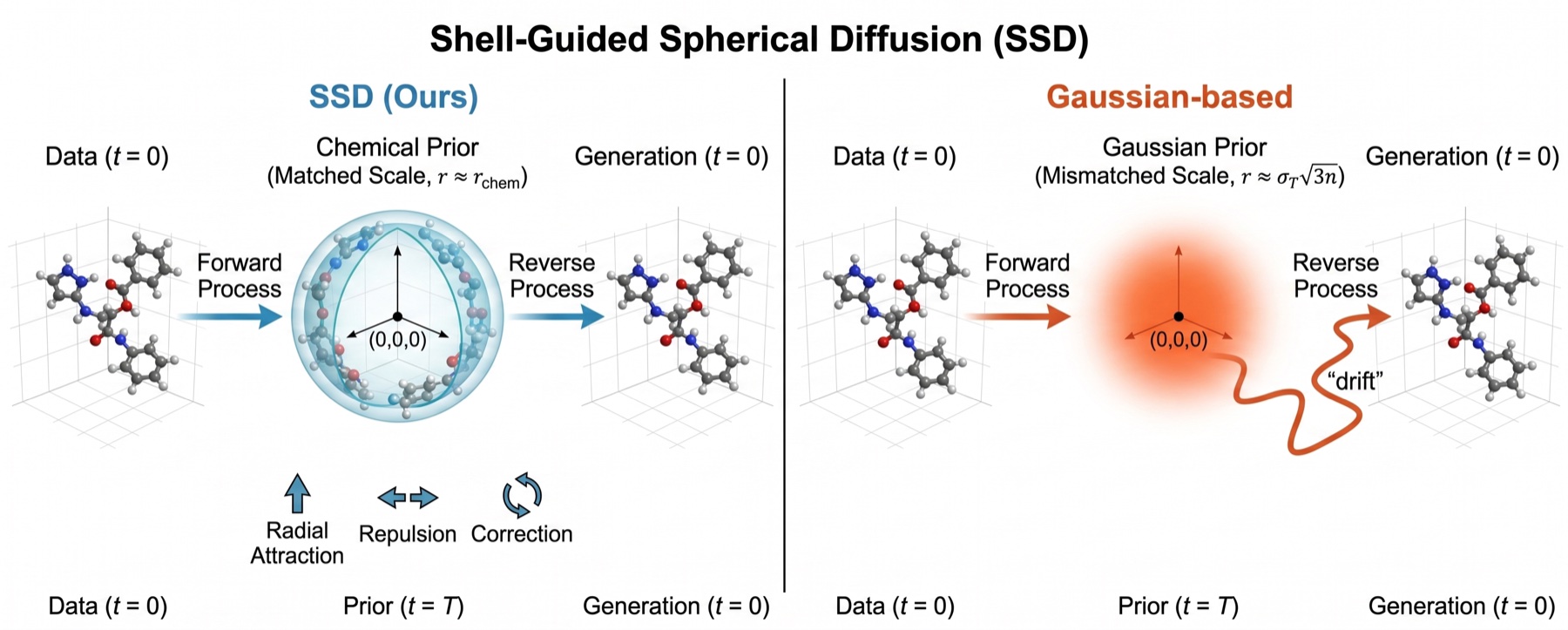
SSD on the left, a standard Gaussian prior on the right, at the same scale. Drag to rotate.
Toy 14-atom molecule for intuition, not model output. Both panes use the same scale.
Training
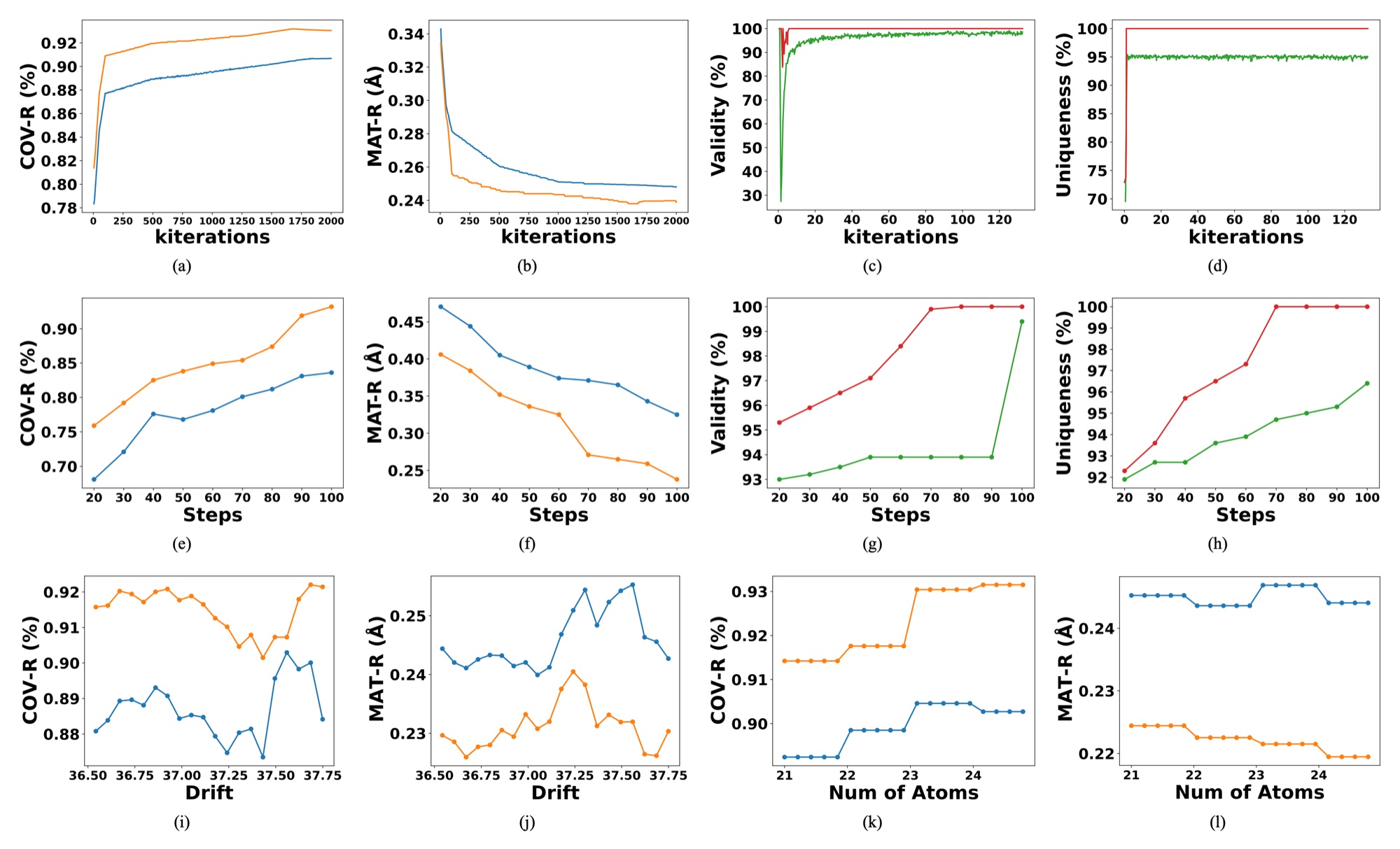
The backbone is trained as usual. Only its noisy inputs change: they are drawn in closed form around SSD's straight-line forward path instead of Gaussian noise. The loss form, optimizer, and training cost stay the same. Training curves converge faster and higher (Fig. 2a–d).
Sampling
Generation starts from a fresh shell sample and follows vrad + vrep + vscore. The atom-to-point pairing π is unknown at inference, so vrad pulls toward the centre. This is a hybrid sampler, not an exact time reversal of the forward process.
Why not a Gaussian?
A Gaussian in 3n dimensions sits on a thin shell of radius σT√3n, which grows with atom count, not with molecule size.
Results
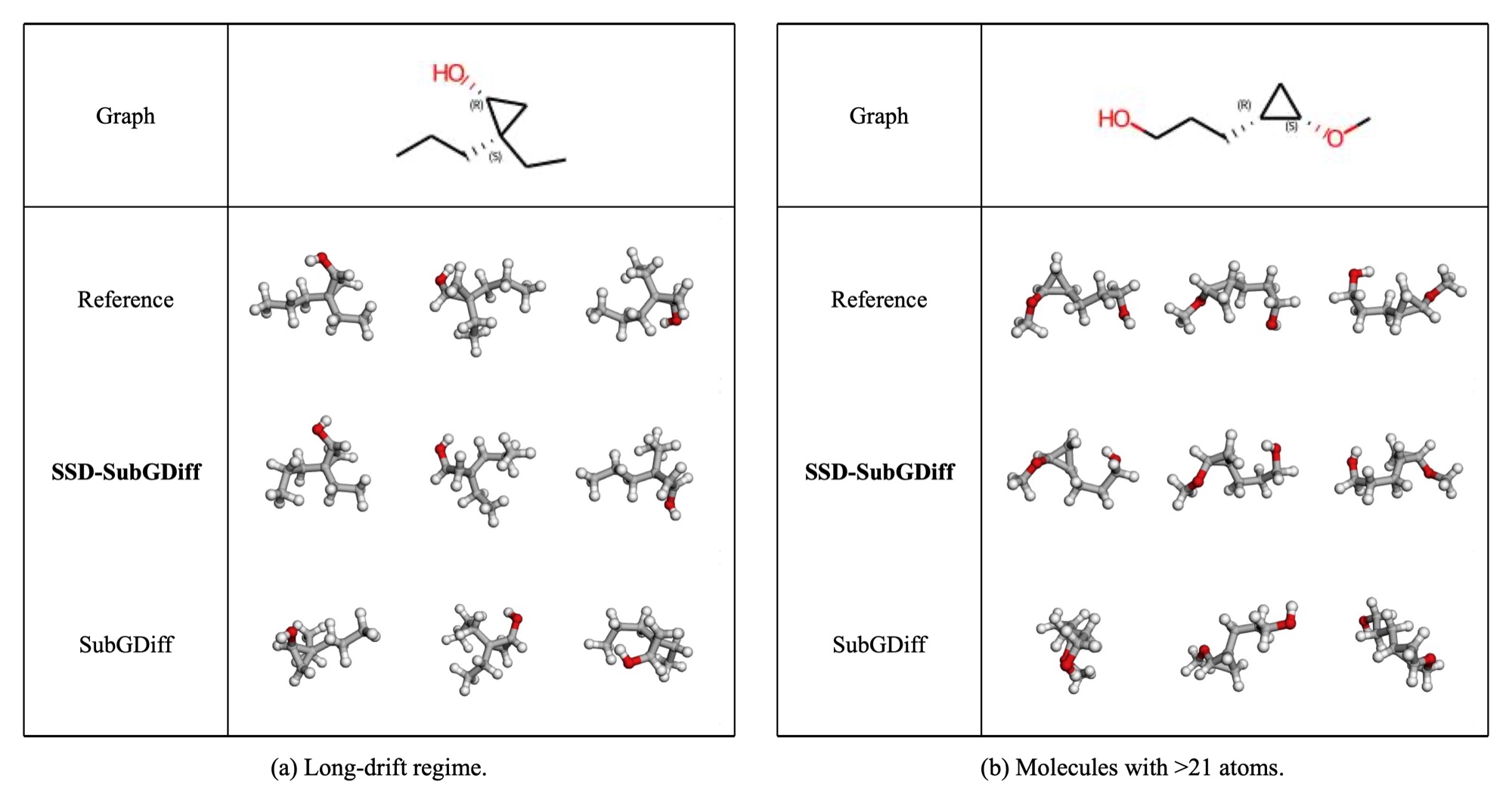
Each backbone is evaluated under its own protocol with identical training and sampling budgets. Mean values are shown. "–" means the metric is not reported in the original paper. SSD entries are single runs (seed 42); see Tables 1 and 3 in the paper for medians and three-seed statistics. The MCF gain on Drugs (+0.76 COV-R) is sign-consistent but not statistically significant. SSD-Flow also swaps SemlaFlow's encoder for a lighter EDM-style one (Appendix M.1).
| Model | Data | COV-R ↑ | COV-P ↑ | MAT-R ↓ | MAT-P ↓ |
|---|---|---|---|---|---|
| GeoDiff | QM9 | 80.36 | 53.66 | 0.2820 | 0.6673 |
| SSD-GeoDiff | QM9 | 92.00 | 61.40 | 0.2425 | 0.4188 |
| GeoDiff | Drugs | 64.12 | 52.79 | – | – |
| SSD-GeoDiff | Drugs | 91.69 | 70.23 | 0.8463 | 1.1543 |
| SubGDiff | QM9 | 90.91 | 50.16 | 0.2460 | 0.6114 |
| SSD-SubGDiff | QM9 | 93.20 | 63.50 | 0.2380 | 0.4100 |
| SubGDiff | Drugs | 76.16 | – | 1.0003 | – |
| SSD-SubGDiff | Drugs | 92.50 | 71.10 | 0.8300 | 1.1400 |
| Model | Data | COV-R ↑ | COV-P ↑ | MAT-R ↓ | MAT-P ↓ |
|---|---|---|---|---|---|
| MCF | QM9 | 95.00 | 93.70 | 0.1030 | 0.1190 |
| SSD-MCF | QM9 | 96.15 | 94.61 | 0.0993 | 0.1087 |
| MCF | Drugs | 84.70 | 66.80 | 0.3900 | 0.6180 |
| SSD-MCF | Drugs | 85.37 | 68.82 | 0.3792 | 0.6089 |
| Model | Data | AtomStab ↑ | MolStab ↑ | Valid ↑ | Unique ↑ |
|---|---|---|---|---|---|
| EDM | QM9 | 98.7 | 82.0 | 91.9 | 98.9 |
| SSD-EDM | QM9 | 99.3 | 99.8 | 100.0 | 100.0 |
| EDM | Drugs | 81.3 | – | – | – |
| SSD-EDM | Drugs | 90.5 | 70.1 | 98.5 | 99.2 |
| SemlaFlow | QM9 | 99.9 | 99.7 | 99.4 | 95.4 |
| SSD-Flow | QM9 | 99.9 | 99.9 | 100.0 | 100.0 |
| SemlaFlow | Drugs | 99.8 | 97.3 | 93.9 | 100.0 |
| SSD-Flow | Drugs | 99.8 | 97.6 | 100.0 | 100.0 |
| Variant | Init. / Prior | Dynamics | COV-R ↑ | COV-P ↑ | MAT-R ↓ | MAT-P ↓ |
|---|---|---|---|---|---|---|
| (1) Gaussian baseline | Gaussian | vSubGD | 90.91 | 50.16 | 0.2460 | 0.6114 |
| (2) Gaussian + rep./corr. | Gaussian | vrep + vscore | 90.95 | 50.20 | 0.2455 | 0.6098 |
| (3) Shell(rGauss) | Shell(rGauss) | None | 90.92 | 50.18 | 0.2462 | 0.6107 |
| (4) Shell(rGauss) + SSD dyn. | Shell(rGauss) | vrad + vrep + vscore | 91.50 | 51.00 | 0.2443 | 0.6020 |
| (5) SSD (ours) | Shell(rSSD) | vrad + vrep + vscore | 93.20 | 63.50 | 0.2380 | 0.4100 |
| Method | Regime | Radial dev. ↓ | Path excess ↓ |
|---|---|---|---|
| SubGDiff | SDE | 0.4534 | 246.91 |
| SSD-SubGDiff | SDE | 0.1781 | 1.71 |
| SemlaFlow | ODE | 0.2145 | 1.29 |
| SSD-Flow | ODE | 0.1096 | 1.11 |
Diffusion models for 3D molecular geometry almost always use an isotropic Gaussian prior. Its Frobenius-norm scale σT√3n is set by the noise level and atom count, not by chemistry. The result is a scale mismatch that grows with n and produces high spatial entropy and unstable early trajectories. We introduce Shell-guided Spherical Diffusion (SSD), a model-agnostic framework that replaces the Gaussian prior with a chemically scaled spherical-shell initialization. It adds coordinated radial attraction, short-range repulsion, and an SE(3)-equivariant correction field to both the forward and reverse processes. Initialization and dynamics have to be designed together: neither a shell alone nor radial fields alone reproduces SSD's stability or accuracy. We evaluate SSD on five coordinate-space backbones (GeoDiff, SubGDiff, EDM, SemlaFlow-style flow matching, and MCF), each under its own evaluation protocol. With identical training and sampling budgets, SSD consistently improves both quality and diversity. It lifts weaker backbones such as GeoDiff and EDM to match or surpass stronger diffusion-, VAE-, and flow-based baselines. SSD is therefore a plug-in geometric enhancement for coordinate-space molecular generation models that changes neither their architectures, loss functions, nor training pipelines.
Team
Chen-Sheng GuMaxora AI · NTU
Hung-Min HsuUniversity of Washington
Kevin LinMicrosoft
Ray-I ChangNational Taiwan UniversityCite
@inproceedings{chuang2026ssd,
title = {{SSD}: Shell-Guided Spherical Diffusion for Molecular Geometry Generation},
author = {Chuang, Yun-Yen and Gu, Chen-Sheng and Hsu, Hung-Min and Lin, Kevin and Chang, Ray-I},
booktitle = {Advances in Neural Information Processing Systems (NeurIPS)},
year = {2026}
}